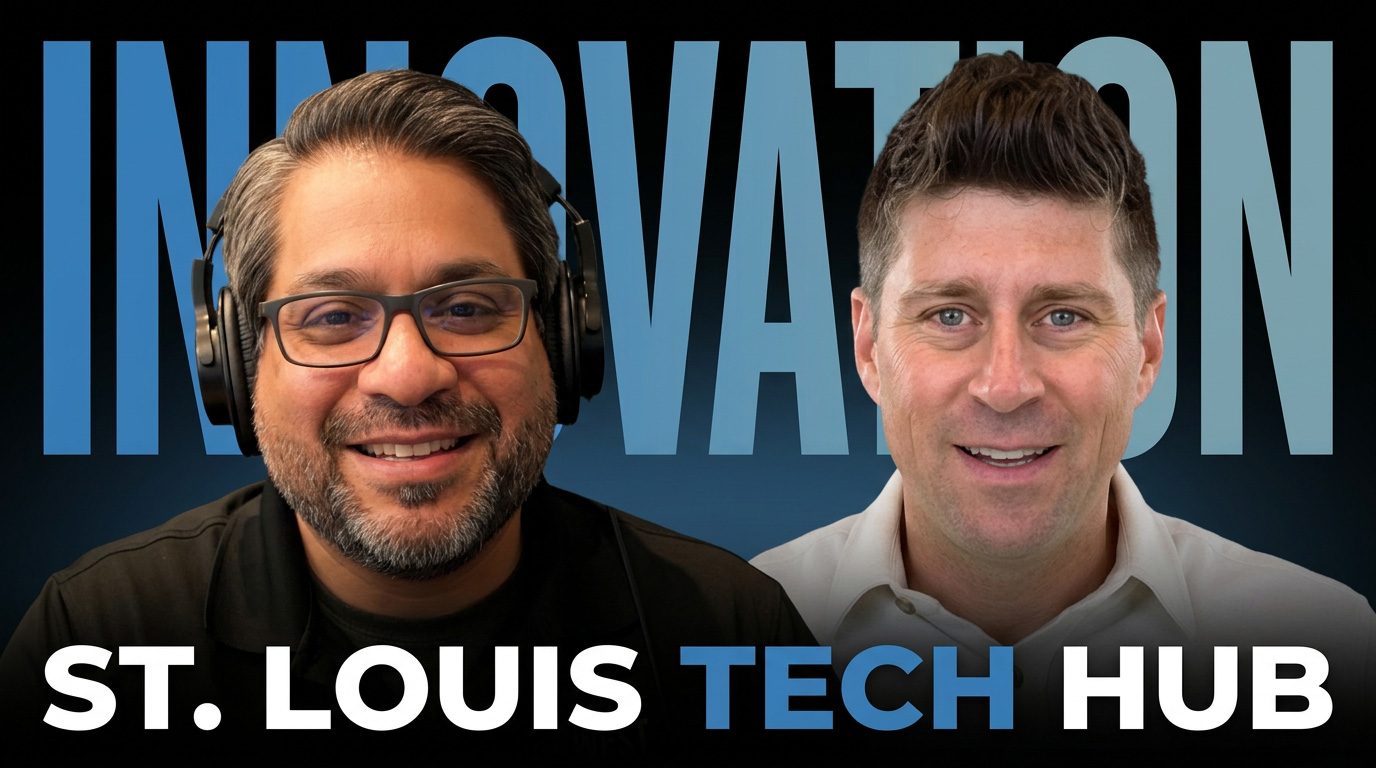
In the first episode of the Banking on St. Louis series, host Josh Rodriguez sits down with Doug Wilber, operating partner at venture capital firm SixThirty, to explore why St. Louis remains one of the most important and misunderstood financial services hubs in the country.

Doug explains how SixThirty, named for the iconic height and width of the St. Louis Arch, has evolved from an accelerator into a thesis‑driven venture fund investing at the intersection of health, wealth, and privacy. With limited partners ranging from credit unions and banks to global financial and insurance institutions, SixThirty focuses on solving real problems faced by Main Street consumers, from retirement readiness and aging in place to financial access and personal privacy.
Doug Wilber contact information:
Email: [email protected]
Linkedin: linkedin.com/in/dougwilber
St. Louis is the second‑largest financial services hub in the United States, home to tens of thousands of industry professionals, global operations centers, and deeply rooted institutions. Doug shares why the future of St. Louis depends on greater collaboration, clearer roadmaps for founders, and creating reasons for innovators from across the country to visit, engage, and eventually build here.
From startups and fintech partnerships to cost of living, talent retention, and community pride, this episode sets the stage for a deeper look at what is possible when a city bets on its people and ideas.
Links to topics discussed:
Buy Now Pay Later
Plinqit Savings Tool
How to Listen:
Subscribe on your favorite podcast player so you never miss an episode:




Follow Banking on You Podcast for updates and past episodes:
Facebook | Instagram | TikTok | Threads | LinkedIn
Banking on You is powered by West Community and Tigers Community Credit Union.
Transcript
Host Josh Rodriguez
Hey, this is Josh Rodriguez. Thank you for listening to Banking On You, powered by West Community and Tigers Community Credit Union. To the outsider, St. Louis is a city of contradictions and has a deep, rich history. The famed Mississippi River, the long legacy of the St. Louis Cardinals, the rabid electric fan base of the St. Louis Blues. Of course, there’s the 1904 World’s Fair, which became the standard by which all fairs would be measured. Lewis and Clark embarked on their cross-country trek from nearby St. Charles, which is a St. Louis suburb. And then there’s the more recent struggles that seem to dominate the media narrative. You know, crime, racial tension, political corruption, a faltering downtown, the infamous Delmar divide, multiple instances of white flight leaving historic, once elegant neighborhoods, now crumbling, abandoned, and in some cases, quite dangerous.
But you know, those of us who actually live here see it as so much more. Historic, of course, yet proudly cutting edge. Challenged? Well, sure. But stubbornly resilient. Deeply rooted, but occasionally still figuring out what it wants to be next.
In this brand new series, Banking on St. Louis, we’re diving deeper than those headlines could ever cover. We’ll take a clear look at the great things happening across our region, the innovation, the partnerships, the forward progress, but also the hard truths about the obstacles we face and the thought patterns that need to be reevaluated and reset.
This series is betting on people, betting on ideas, betting on the side of a great city still in pursuit of greatness. That’s why we’re banking on St. Louis. I’m your host, Josh Rodriguez. Let’s get into it.
Josh Rodriguez
Awesome. So the big question that I’ve got is I see that you are a Nittany Lion, state alum. so is there any animosity towards… Doug Wilber is the operating partner at venture capital firm SixThirty. We’ll find out more about SixThirty later directly from Doug. He advises and consults with various portfolio companies as they refine their go-to-market strategies and partner up with large scale enterprise businesses.
Wilber himself is no stranger to the startup and fintech world as he led his own company, Denim Social, to a successful exit by Capacity.com back in 2023. He’s deeply embedded in the St. Louis startup ecosystem and he serves on the board of directors for multiple SixThirty portfolio companies like Equipify, Unreal Estate, and Ripple Shot. Doug holds a BS in marketing and international business and an MBA with a focus on product development and brand strategy from Penn State University.
For the Wilber family, graduating Penn State is more like a family tradition, which is kind where we jump into the conversation. Here we go.
Doug Wilber
I’ll tell you a funny story. my dad, so I’m a multi-generation Penn Staker. And my dad, my parents still live in upstate New York. They still live in the house. They bought one house their entire life. It’s the house they grew up in. It’s the house they still live in today. Small town in upstate New York. And my dad, this is how much my dad hates Ohio State. They like to drive when they come to visit us in St. Louis. And in order to drive from upstate New York to St. Louis, you have to drive through pretty much all of Ohio. Like you enter in the Northeast corner of Ohio and then you exit on the Western border. It’s about five-ish hours of driving in the state of Ohio. My dad will fill up for gas in Erie, Pennsylvania. He will not let my mom get a drink. It’s like, everybody goes to the bathroom, fill up gas, because we’re not stopping until we get through Ohio. Refuses to spend money in the state of Ohio.
Josh Rodriguez
That’s awesome. I thought you were going to say he takes this long, secure route to avoid Ohio.
Doug Wilber
I do know, Michigan people I do know will go the Canadian way in order to avoid going through a lot.
Josh Rodriguez
Wow. Wow, that’s dedication and loyalty. Or hatred. One of the two. not sure which.
Doug Wilber
Whatever. Ashen for your school. Right?
Josh Rodriguez
Cool. So hey, let’s talk a little bit about your work with SixThirty and about SixThirty itself. So let’s dive into that.
Doug Wilber
Sure, sure. Well, you know, we can start with sort of the history of SixThirty and really what we’ve evolved into over the last, call it decade plus or so. By the way, fun fact for the day, we get our name SixThirty from the height and the width of the St. Louis Arch, which is SixThirty feet tall and SixThirty feet wide. So our name is sort of an homage to the city that we serve and the place that we live.
What we’ve evolved to from our earliest days when we first launched SixThirty, it was much more of a sort of accelerator model and understanding that St. Louis by and large is the second largest financial services hub in the country. 84,000 financial services professionals call St. Louis home.
Josh Rodriguez
Second only to New York City. that? Yeah, yeah. Interesting. I don’t think many people know that.
Doug Wilber
It’s a fun fact that we like to keep in our back pocket, right? And so 84,000 financial services professionals call St. Louis home. The original idea behind SixThirty was what that translates to is a high degree of buying power. And wouldn’t it behoove FinTech founders to set up shop in St. Louis? And so that was the original concept and the original idea brought together by Jim McKelvey, who, know, co-founder of Square, he and Jack are both St. Louis natives, both care deeply about this community.
Working in collaboration with the Chamber of Commerce to bring what we sort of call 631.0 to market, which was, hey, let’s entice early stage founders, early stage FinTech founders to set up shop in St. Louis. I would say by and large, the key learning that we had coming out of that was not so much that we should be planting FinTech founders per se in St. Louis, but that there is an ecosystem that can be leveraged and that there’s shared sort goals and objectives that can be leveraged amongst these 84,000 financial services professionals to help them better collaborate, help them to better understand how the world is changing around them, help them to better understand how they might be able to sort of make it known that this is a great place if you’re a founder that maybe lives in New York or San Francisco or other larger sort of tech oriented cities that maybe you build your products there, but you sell it here.
And so that was kind of the keen insight that we had after getting SixThirty off the ground. And what that’s evolved us into is really a true early stage venture fund. And the differentiator that we have as a fund is, I think, a couple of things. One is that we are very collaboration oriented, ecosystem oriented venture fund. Secondly, we are very thesis oriented. And our thesis and our investment thesis, which has not wavered.
Even though people sort of looked at us a little side-eyed when we launched our last fund back in 2021, was that our fundamental belief is that we should be investing at the intersection of your health, your wealth, and your privacy. And those three things in collaboration together, if you look at the Main Street consumer and that Main Street consumer who is saving for retirement and worried that they’re not gonna have enough money to live out their days, right? We’re living longer and we’re living more healthfully.
and maybe most people’s retirement plans have them maybe dying at 89 and a half. Well, what happens when you’re living to 93 years old? Like a lot of us are. Right. And what happens when you’re living more healthfully and you want to age in place in your home, but that home wasn’t set up for you to age in place in, and it requires you to build the downstairs en suite. It requires you to be the person who puts the new roof on the house. Right. And yeah, maybe you’re not going to die of heart failure, but you still need a knee replacement. And so all those things are sort of like, diametrically opposed to each other in many ways, and it’s forcing many consumers to make choices. Do I buy the new roof this year or do I get the new replacement? Do I pull money from my 401k even though I probably don’t have enough to live through my final days to fund the construction project to build the first floor ensuite, right? All of these challenges that mainstream consumers are facing, which are real. Our third thing that is a differentiator
is how we’re solving for that. And we’re solving for that through who our LPs are. So our superpower as a fund is that our LPs in our fund are feeling these problems in real time. And they’re feeling these problems each and every day as they go to market and how they serve their customers. So when you think about a West Community Credit Union as a leading credit union, when you think about an Edward Jones, when you think about an RGA as the largest reinsurer in the world.
When you think about a Bank of New York, a UNUM, the list goes on and on. We’ve got 15 flagship LPs who sort of sit across the broader financial services spectrum, the financial services ecosystem that give us as a venture fund 360 degree high fidelity view and conviction around the problems to solve at that intersection of your health, your wealth, and your privacy.
Josh Rodriguez
Describe what an LP is for those that might not be familiar.
Doug Wilber
Oh sorry, yeah, LP is a limited partner or an investor in our fund.
Josh Rodriguez
And these are partners anywhere from, like you mentioned, West Community Credit Unions, because we’ve been working with SixThirty since, I believe, 2017. So getting close to a decade now. Yeah, it’s been quite a while. And other institutions that you mentioned that are quite large but are based here in the St. Louis area. And all of them, like you say, can see these issues, these problems that the consumers are facing. And there’s a solution for them. But we might not be able to develop them ourselves.
Doug Wilber
So we, in many ways you shouldn’t develop them yourselves, right? Like you should be leaning on the innovators and the technologists who are bringing these solutions to market. Our job as a venture fund is to connect those two entities, right? So connecting our investors who are by and large, by the way, non-competitive. So one of our other differentiators is that in Edward Jones, a West community, a commerce bank and RGA are not showing up at our investment committee and sitting on their hands.
Because they don’t want to speak up in front of a competitor, they’re saying, this is really cool. I actually can be open and honest and transparent about what our challenges are. I can be open and honest and transparent and collaborative with my fellow investors because we all have opportunity to grow and gain by working together, right?
Josh Rodriguez
Right, and you’ve done great job with that because I’ve sat in those exact rooms with the other LPs and you’re right, there is no sense of competition, not withholding secrets, we’re all working together for the best of our members, our consumers, our customers, etc. It’s a really great ecosystem. And it’s different, so in a lot of ways, the credit union world is now joined into, and this is not anything really new, it’s been…
It’s been in the works for a while, but the fintech ecosystem, a lot of us have dipped into, you know, these partnerships, these relationships, but this is kind of a different approach rather than going out and finding partners or finding products or services to meet the needs of our members. This is like a larger cooperative or collaborative that brings everybody together in a very unique way and takes, like you said, the competition out of it, but it’s just for like the greater
The greater good. That’s an overused phrase, but it really kind of boils it down.
Doug Wilber
I mean, yeah, for sure. Are we commercially oriented? Absolutely. We’re a venture capitalist at end of the day, right? So we are looking for opportunities to invest in problems. We are very problem, like, you know, where we invest, maybe I’ll take a step back, where we invest in a founder’s journey is typically pretty early. We intercept them fairly early in their journey, right? Seed, Series A, and sort of venture capital parlance, like we’re some of the first professional money that is invested into one of these startups.
And different, I would say, than other venture funds who might say, hey, we’ve got 150 banks as investors in our fund, or we’ve got 200 credit unions as investors in our fund. The sales pitch for that founder by and large is, hey, look at all the places you can sell, which doesn’t really end up working out all that well by and large versus our model, which says, hey, look, the sales pitch is not come in and pitch to West Community Credit Union or come in and pitch to Edward Jones or Commerce Bank or any of these investors in our fund.
It’s come in, collaborate with them, learn from them, refine your approach, refine your model. And yes, maybe there is a commercial opportunity that will surface at some point in the future, but it is not our sales pitch. it’s, by the way, it’s not uncommon for our founders and for our LPs to find commercial opportunities. It’s not uncommon for the LPs to reinvest and invest on their own in some of these initiatives, right? So there’s commercial opportunities are abundant, co-investment is abundant. We haven’t yet had anybody acquire one of our portfolio companies, but you know, it’s it’s probably coming. But I would say it comes from a different positioning. It doesn’t come from a positioning of here’s a pool of investors that you can sell to. Instead, it comes from here is a group of highly placed non competitive leaders in their industry that you can learn from, you can collaborate with and that you can ultimately be a much stronger and well-rounded company because you’re learning from these incumbents.
Josh Rodriguez
Tell us about a couple of your success stories, some of those that really stand out.
Doug Wilber
Yeah, I mean, you guys are a perfect example. mean, you know, not to put you on the spot, but I mean, you’ve really been, know, West community has been at the forefront of digging in, both from a diligencing perspective, right? When we’re looking at a new idea and we’re getting to know a founder, being very open and transparent about the challenges that you’re facing and how do you better serve your members, and then bringing those opportunities forward in helping to be some of those kind of first customers for some of our founders.
I’m on the board of a company called Equipify, which I know you guys are super interested in and working with today, right? Imean, our ability to build conviction and thesis around the idea that the Affirms and Klarnas and the after pays of the world are building a wedge between you, the credit union and your member. And what Equipify is bringing to market is an ability for you, the credit union to tamp down that wedge and deliver a more modern buy now pay later flexible payment solution for your members that is highly differentiated in the marketplace.
Josh Rodriguez
And very early, very early in comparison to what other credit unions have been able to do. partnership with Equipify put us at the forefront, almost the bleeding edge of bringing buy now pay later to our members. And when others were just looking into the product and into the service, we were already deploying and we were way ahead of the curve there because of our relationship with SixThirty and the access to Equipify. The same with another fintech we were working with Plinqit, which is a savings product.
Yeah, same idea there. And we’ve been we’ve been partners with them for I think it’s been a couple of maybe even longer than that. But the same relationship came about because of our involvement with SixThirty. It’s been a really great thing for our members as well. So there’s a lot of emerging tech hubs around the country. You know, we think of Austin, we think of Nashville, Atlanta, Salt Lake City, all these different areas. But your approach, as you’ve just explained it, is a little different than saying, hey, come here and we’ll give you an office and the incubator type approach, which is great. Nothing wrong with that. But it’s a different model. So how has the SixThirty model, how has that benefited the St. Louis Metro itself? Definitely has helped the LPs that have been involved, but how has it grown like the tech scene or the metro area itself?
Doug Wilber
Sure, sure. Well, I will say what we’ve learned, and by the way, our investor base is not just St. Louis domiciled financial services firms, right? We have investors from all across the country. It just so happens that being in such a large financial services hub like St. Louis, know, a lot of our investors are domiciled here.
Josh Rodriguez
Right, and you’re also international as well. You’re not just…
Doug Wilber
We deploy capital in the internet, right? mean, you know, it’s not that we’re just sort of thinking here. What I will say is, is that our sort of global thinking and our sort of, you know, coast to coast thinking on building a collaborative ecosystem has proved to be very successful. And not to, you know, pat ourselves on the back too much, but you know, we’re a top decile, top quartile performing venture fund.
We’ve had now, and don’t quote me on this, I think it’s now 25 positive exits since inception. We’ve sold, you know, some of our founders in those companies have gone on to be acquired by folks like Encino and Carta and a whole host of other sort of big national brands. And so we know our model works really well.
How can we take all of our best practices that we’ve learned on how to build an ecosystem and how can we apply it to our community just in St. Louis? And how can we ignite that collective horsepower of those 84,000 financial services professionals in St. Louis? And whether it’s MasterCard’s Global Operations Center this year. Not a lot of people know that. How large the MasterCard Operations Center is and the strategic importance that it is for MasterCard’s business as a whole. That’s here in St. Louis. You know, as I mentioned before, we have very large sort of wealth management firms like Edward Jones and Stiefel right here in our backyard. You have any number of very highly successful top performing credit unions and banks. You have tons of RIAs and other sort of, you know, independent wealth advisors like PlanCorp here in town.
Before we can have a conversation about convincing a founder, to move from San Francisco to St. Louis or to move from New York to St. Louis or to graduate from WashU and stay here in town and build their startup. What we really need to do is give them a roadmap of what we’re looking for. Let’s bring together top performing financial services firms here in town. Let’s engage with them at the executive level, some of the most senior levels in those organizations, CEO, CFO, COO, right? And collectively identify what are the challenges you are facing? Where do you want to take your business? What are the existential threats that you’re facing? And how can we collaborate to solve them together? And whether it’s from a talent perspective, talent development, talent recruitment, talent retention, whether it’s co-building and co-inventing solutions, or if you’re a founder who’s also solving those problems in the marketplace, you should jump on a plane to St. Louis and come talk to us.
And I’ll give you an example of that on the SixThirty side. So I work very closely with one of our portfolio companies, a Palo Alto based AI company called Cognacore. Their CEO, Sindhu Joseph, comes to St. Louis, I want to say maybe once every six to eight weeks. And every time she comes here, not only is her calendar packed, because we’re able to give her opportunities to sort of meet with people and collaborate and to learn and all these, all the rich things that we can be doing by cultivating this ecosystem. But I will tell you, every time she comes here, she says, man, I should probably just move to St. Louis. Man, my startup CEO salary would go way further here than it would in Palo Alto. And so I think getting folks to drink the Kool-Aid will only happen if they can start to show up here. And then we can have a conversation about how do we build here, but we actually have to ignite the ecosystem first.
And that’s what we’re looking to solve here in St. Louis, which is today at this point in time, we’re the second largest financial services hub in the country. If we want to stay number two, right, and we want to not, you know, not drop in these rankings and we want to stay relevant and at the forefront of what good looks like in financial services, we need to find better opportunities to collaborate. And what we’ve we’ve sort of seen is by and large, like our superpower as a fund is our ability to convene these groups, to build ecosystems, to build opportunities for trusted collaboration. The end goal being we want everybody in New York, San Francisco, Austin, Dallas, wherever. If you’re a founder anywhere else in the country, we want you to know that you need to be spending like Cognacore does. Every six to eight weeks, you should be taking a field trip to St. Louis.
Josh Rodriguez
Right. Right. And that they’re going to notice like that founder has the cost of living here is much more affordable.
Doug Wilber
It’s just about cost of living, It’s about, and certainly that’s a nice benefit and our school districts are amazing. I mean, we all know, right? Like once you get here, it’s really hard to leave because out of incredible community that it is here. But I would say for a founder, that’s one thing. I would say the more important thing for a founder is, oh, if I show up in St. Louis, I’ve got lots of different folks that I can talk to that maybe end up in a commercial arrangement or at a minimum.
I’ve got a convening forum that will really help me to understand what the broader financial services ecosystem and the broader financial services market is looking for from me as a founder. Because I can show up in St. Louis and have very deep, rich and meaningful conversations with a collaborative of executives that are all here in one town.
Josh Rodriguez
Right, it’s currently a pretty well-kept secret what we’ve got here in many different ways.
Doug Wilber
My personal mission and my personal goal is to make it not a well kept secret.
Josh Rodriguez
Yeah. Awesome. And that’s this entire, this whole series here on the Banking on You podcast is Banking on St. Louis. And that’s our, our goal to talk about the issues that St. Louis is facing and to reveal that secret to everyone because this is a fantastic place, not just to live, but to work and to collaborate and, and to, to, learn from each other, especially in the financial services world. As you just mentioned, it’s a, it’s a pretty incredible place to be.
Let’s not talk about the weather, which we did earlier, but you can survive the weather. There’s more important things than the amount of snow we get. We really don’t get much snow, but it really is a great place to live. And Doug, you’re doing some fantastic work. And fortunately, there’s a lot of negativity and negative press around what’s happening in St. Louis. And every town has its problems.
Doug Wilber
Every town has its problems, right? And I moved here from Chicago a little bit more than 12 years ago. So the joke I say, and I’ll say it on this podcast so everybody can hear me say it maybe once and for all, is I affectionately call St. Louis, Son-in-law City. Because if you marry a girl from St. Louis, somewhere in the fine print of that prenup, even though I don’t have a prenup, but fine print of the prenup is relocation required. Oh, that’s hilarious. And so it happened to me about 12 years ago. We made the decision to move down here from Chicago to be closer to my wife’s family and raise our kids near grandparents and aunts and uncles and cousins and all that good stuff, right? And it’s been phenomenal. And I will say like, what’s interesting for me having moved here and made the decision to move here is that by and large, what I find is the people who have moved here have a very different story to tell about St. Louis than the people who have only ever been here. And…
The people who move here, and maybe it’s just that, you know, like when you’ve moved somewhere new, you kind of get out and about and you sort of explore more and you’re not in setting your routines and all that good stuff. But I have found that like, for me personally, as a father of two, my wife and I both work, you know, our kids are very active in school and sports and all of that. This is the perfect place to be. I have access to great restaurants. I have access to great cultural things, music and concerts and all those things are going on. The amenities that we have as a city are beyond top tier. It’s easy to get around. The cost of living is low. The schools are great, right? I’m a beer guy. I love the brewery scene here in town. I mean, there’s not much to not like.
Josh Rodriguez
Oh, absolutely. No, you’re totally right. We moved here from California and everybody says, why would you do that? And that’s a whole other story. But coming to St. Louis, we found it is the perfect place to raise a family. And there is so much to do. Unfortunately, and I think this this goes back further than you or I moving into the area. St. Louis often lives in the shadow of Chicago or other metro areas. And we don’t have to. We are awesome in our own right.
Doug Wilber
I think this is some of the work that we’re doing at SixThirty to kind of build this, to elevate how people perceive us in our swim lane, right? And that’s the other thing that, you I’ve encouraged a lot of folks in St. Louis is like, look, we don’t have to be good at everything in St. Louis. But we have to be good at the things we’re good at. And it’s like when you look at your kid’s report card and they walk in like, hey dad, here’s my report card. And you look and it’s like, I mean, hopefully it’s all A’s or at least A’s and B’s, right? But as a parent, your inclination is if there’s a “C” on that report card, you’re gonna zero in on that. My opinion is, you actually, that’s the wrong approach. Because nobody’s gonna be good at everything. What we have to do is say, the A that you got, does that feel good to get an A in that class? Do you like that class? And if so, why don’t I double down on that and just say, just survive the C. Let’s double down on the A so you can be the best version of yourself. And so for me, when it comes to St. Louis, I think of financial services as place we get an A. I think of, healthcare as a place that we get an A. I think of bio and life sciences, ag, all the work that the NGA is doing. There’s like places that we get A’s. Let’s double down. Right. Right. And make this a place where if you’re an executive that is in that swim lane at anywhere else in the country that you know this is a shiny place on the hill.
Josh Rodriguez
Right, right. And on the other side of that, you have the culture and the arts and the restaurants you mentioned. All of those wonderful things focus on those strengths and you know, the negatives. Everybody has negatives, but they are what they are. Yeah, let’s focus on those. Doug, where can someone get a hold of you or reach you if they’re interested in SixThirty or more information about any of the above?
Doug Wilber
I’m a pretty easy dude to find. So, you you can always find me on LinkedIn. You can shoot me an email. It’s super duper easy. It’s just [email protected]. So you can find me there. I’m pretty much, I don’t know, out and about at almost all of the various initiatives here in town as well. So I’m a pretty easy guy to find.
Josh Rodriguez
All right, thanks Doug, appreciate your time.
Doug Wilber
Thank you.
Josh Rodriguez
It seems the most meaningful work shaping St. Louis is quiet, just off stage, mostly unseen to the majority. Doug’s work at SixThirty is a prime example. The impact may not always be visible to those outside the startup or fintech worlds. Even many inside St. Louis may not realize just how influential this ecosystem has become. It certainly will influence financial services, executives, and professionals as they help founders refine ideas, solve real problems, and bring innovation to market. Not just here in St. Louis, but around the world. When that kind of experience and collaboration fuse together, it creates something powerful. And that’s the story we’re telling in this series. Not just of a city with challenges, but of a city rich in talent, relationships, and opportunity. A city quietly shaping the future of financial services
You could say the future of the financial technology industry could be banking on St. Louis. Thanks for joining us for the first episode of banking on St. Louis. Josh Rodriguez. And remember, here at West Community and Tigers Community Credit Union, we’re banking on you.